Winter’s charm often comes hand-in-hand with the arduous task of snow removal, a chore that can quickly become overwhelming without the right tools. If you’re tired of battling heavy snowfall with just a shovel, a snow blower is your ultimate ally, transforming hours of back-breaking work into a manageable task. But with an array of options on the market, particularly the distinctions between single, two, and even three-stage models, how do you determine which machine is truly best for your specific needs? This comprehensive guide will navigate the nuances of snow blower technology, helping you make an informed decision to conquer winter with confidence.
Understanding Snow Blower Types
Snow blowers are ingeniously designed machines that simplify the process of clearing snow from various surfaces, from compact sidewalks to expansive driveways. Their primary function is to collect snow and propel it away, creating clear pathways and reducing manual effort. Over time, these machines have evolved into distinct categories, each tailored to different snow conditions and property sizes.
The most common types you’ll encounter are single-stage, two-stage, and increasingly, three-stage snow blowers. A single-stage model utilizes a single auger, a rotating paddle system, that directly scoops snow and simultaneously throws it out of a discharge chute. Two-stage snow blowers, as their name suggests, employ a two-step process: an auger first collects and feeds the snow into the machine, and then a high-speed impeller fan forcefully ejects it. The more advanced three-stage models add an accelerator component to this process, further pulverizing snow and ice before it reaches the impeller, offering unparalleled clearing power and speed.
Single-Stage Snow Blowers
|
Our Picks for the Best Snow Blower in 2026
As an Amazon Associate I earn from qualifying purchases.
|
||
| Num | Product | Action |
|---|---|---|
| 1 | VOLTASK Cordless Snow Shovel, 48V | 13.5-Inch Cordless Snow Blower, Battery Snow Blower with Directional Plate (2 * 24V Battery & Dual Quick Charger Included) |

|
| 2 | SuperHandy Electric Snow Thrower Walk-Behind Blower Corded AC 120V 15A 18 x 10 Inch Clearing Path 25 Feet Throwing Distance 720 lbs/Min LED Headlights for Driveway Walking Path Yards |
|
| 3 | EGO Power+ Electric Snow Shovel Attachment, Use with Cordless Power Head Multi-Head System, Battery, Charger and Power Head Not Included - SSA1200 |
|
| 4 | EWORK Corded Snow Shovel 11-Inch 1200W 10A Powerful Electric Snow Shovels, 6-Inch Clearing Depth, 23-Foot Max Throw Distance, Power Snow Blower for Driveway, Steps, Sidewalk, Porch |
|
| 5 | Westinghouse WSnow13S AC Corded Electric Snow Shovel, 13-inches Wide with 20 ft. Throwing Distance, Plows 300 lbs/min for Driveway/Steps/Sidewalk/Porch |
|
| 6 | Brushless Cordless Electric Snow Shovel for use with Makita 21V Battery, 12” Snow Thrower with Adjustable Direction, Lightweight Snow Removal Tool for Driveway,Patio,Walkways |
|
| 7 | Westinghouse WSnow11S AC Corded Electric Snow Shovel, 11-inches Wide with 20 ft. Throwing Distance, Plows 300 lbs/min for Driveway/Steps/Sidewalk/Porch |
|
| 8 | SuperHandy Electric Snow Thrower Adjustable Angle 17" Clearing Width 5.7" Intake Height 23' ft Throw Curved Serrated Blade 48V-2Ah Battery Portable Wheels Easy Maneuver Safety Switches Comfort Handle |
|
| 9 | Cordless Snow Blower(No Battery), Compatible with Dewalt 20V Max Battery, 20" Brushless Snow Thrower with Directional Plate & LED Lights, Electric Snow Blower Ideal for Walkways and Driveways |
|
| 10 | EGO Power+ SNT2110 Peak Power 21-Inch 56-Volt Cordless Snow Blower with Steel Auger Battery and Charger Not Included,Black |
|
Single-stage snow blowers are typically compact and lightweight, making them highly maneuverable and easy to store. Their augers often make direct contact with the clearing surface, which is excellent for scraping snow clean off paved areas like driveways and sidewalks. They are primarily powered by electric motors (corded or battery) or smaller gas engines. These machines excel in situations with light to moderate snowfall, generally up to 8-10 inches.
However, their direct ground contact makes them unsuitable for gravel surfaces, as they can pick up and propel rocks, causing damage to the machine or surroundings. They also tend to struggle with heavy, wet, or icy snow and are less effective for larger properties or significant snow depths.
Two-Stage Snow Blowers
When facing heavier snowfall and larger areas, two-stage snow blowers step up as the workhorses of winter. These models feature a robust auger that gathers snow and directs it towards the center, where a powerful impeller then propels it through the chute. This two-step action allows them to handle deeper snow, typically ranging from 12 to 18 inches, including wet and heavy varieties. Many two-stage units are self-propelled, easing the burden of pushing, and often come with multiple forward and reverse gears for better control.
Unlike single-stage blowers, their augers usually hover above the surface, making them safe for use on both paved and gravel driveways without launching debris. While more powerful and versatile, they are heavier, larger, and generally require more maintenance than their single-stage counterparts.
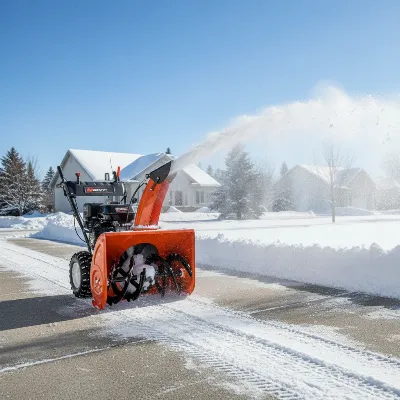 A powerful two-stage snow blower clearing a wide, snow-covered driveway with snow being ejected from its chute
Three-Stage Snow Blowers
For the most demanding winter conditions, such as exceptionally deep snow, heavy icy drifts, or large commercial properties, three-stage snow blowers offer the ultimate in clearing capability. These machines build upon the two-stage design by adding a high-speed accelerator to the auger and impeller system. This third stage pre-chops and accelerates snow and ice, allowing for faster clearing and greater throwing distances, even with the densest snow. Some specialized three-stage systems are designed to clear up to 50% faster than traditional two-stage models.
They are the most powerful and efficient option, capable of tackling snow depths exceeding 18-24 inches and breaking through hard-packed plow-produced snow at the end of driveways. However, their size and power come with increased cost, weight, and reduced maneuverability in tighter spaces. Three-stage technology is often a premium feature, sometimes exclusive to specific brands, designed for those who face extreme winter challenges consistently.
Choosing the Right Snow Blower (Buying Guide)
Selecting the ideal snow blower requires a thoughtful assessment of your specific needs and the unique conditions of your environment. This isn’t just about raw power; it’s about finding the perfect balance of performance, convenience, and value.
Assessing Your Snow Clearing Needs
The first step in your buying journey is to honestly evaluate the demands of your property and local climate.
- Area Size: For small, flat paved areas like sidewalks or short driveways (e.g., up to two cars), a single-stage blower might suffice. Medium to large driveways (up to 15 cars) or longer walkways often call for the power and efficiency of a two-stage model. Extremely large residential properties or commercial spaces will benefit most from a three-stage snow blower.
- Usage Frequency: If you only experience occasional, light dustings of snow, a simpler, more affordable machine is practical. However, if your region sees frequent and heavy snowfalls, investing in a more robust unit will save you significant time and effort over the winter season.
- Snow Type: Light, fluffy snow is easily handled by single-stage blowers. Wet, heavy, or slushy snow, common in warmer climates or during thaw cycles, demands the power of a two-stage or three-stage system. Icy conditions or snow compacted by snowplows are best tackled by the superior breaking and throwing force of a two-stage or three-stage machine.
- Surface Type: Paved, smooth surfaces are ideal for single-stage snow blowers due to their auger’s direct contact. For gravel, uneven, or sloped surfaces, a two-stage or three-stage model is essential, as their elevated augers prevent gravel from being picked up and thrown, which can be dangerous and damaging.
Essential Features to Consider
Beyond the basic stage type, several features can significantly enhance your snow-clearing experience and the effectiveness of your machine.
- Engine Power / Clearing Capacity: Measured in cubic centimeters (cc) for gas models, a higher engine size generally means more power and the ability to clear heavier snow. For electric models, look at battery voltage (V) and amp-hours (Ah) for cordless units, or amperage (A) for corded ones, indicating power and runtime. Consider the clearing width and intake height of the auger, as these determine how much snow can be cleared in a single pass and the maximum snow depth the machine can handle.
- Start System: Gas snow blowers typically offer a pull-start (recoil) or an electric start. An electric start, usually a push-button requiring an extension cord, is invaluable on freezing mornings for quick, reliable ignition, saving you from repetitive pulls.
- Additional Features: Modern snow blowers come with a host of conveniences. Headlights are crucial for clearing snow in low-light conditions, such as early mornings or late evenings. Heated handles provide comfort during prolonged use in frigid temperatures. Adjustable chute controls, often conveniently located on the dashboard, allow you to easily direct the snow’s discharge distance and direction without stopping. For larger or uneven properties, power steering (often trigger-controlled) can make maneuvering heavy two and three-stage blowers remarkably easier.
Budgeting for Your Snow Blower
Your budget plays a significant role in determining the type and features of the snow blower you can acquire. It’s wise to set a maximum budget early, but also understand that investing a bit more upfront can often lead to greater efficiency, durability, and comfort over many winter seasons. Compare not just the initial price but also the long-term value, including potential fuel costs and maintenance requirements for gas models, versus the battery and charger costs for electric units.
Snow Blower Price Segments
Snow blowers are available across a range of price points, with each segment offering different levels of performance and features designed for varying needs.
Entry-Level Models
These are typically single-stage snow blowers, often electric (corded or battery-powered) or smaller gas models. They are characterized by their lighter weight, compact size, and simpler operation. Entry-level machines are best suited for smaller paved areas and light, fluffy snowfalls, usually up to 6-8 inches. They are an excellent choice for homeowners seeking a basic, easy-to-manage solution for occasional snow clearing without a significant investment. While effective within their limits, they lack the power for heavy, wet snow or large properties.
Mid-Range Models
The mid-range segment is dominated by two-stage gas snow blowers, along with some powerful battery-powered two-stage options. These models offer a substantial upgrade in power, clearing width, and snow depth capacity compared to entry-level units. They typically feature self-propelled drive systems, electric start options, and often include creature comforts like headlights and heated handles. Mid-range snow blowers are ideal for average to large driveways, can handle varied snow types (including wet and heavy), and are suitable for both paved and gravel surfaces. They strike a balance between performance, features, and cost, making them a popular choice for many homeowners.
High-Performance Models
At the top tier are the largest two-stage and all three-stage snow blowers, powered exclusively by robust gas engines. These machines are built for heavy-duty, commercial-grade performance, featuring wide clearing paths, powerful engines, and the ability to conquer deep, icy, and compacted snow. Expect premium features like advanced power steering, multiple speeds, heavy-duty construction, and extended throwing distances. High-performance models are designed for very large properties, demanding snow conditions, or professional use, where efficiency and power are paramount, justifying their higher price point and greater physical footprint.
> “Choosing the right snow blower isn’t just about muscle; it’s about matching the machine’s capabilities to your specific snowfall and property challenges. An overpowered machine for a small job is as inefficient as an underpowered one for a large task.” – John Carter, Senior Product Engineer, Outdoor Power Equipment
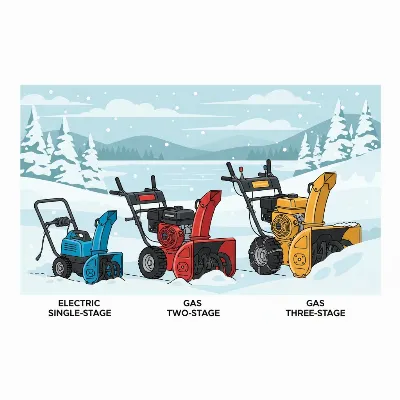 A visual comparison showing different types of snow blowers lined up, from small single-stage to large three-stage models
Key Considerations for Top-Performing Snow Blowers
When aiming for a top-performing snow blower, regardless of its stage, certain characteristics consistently stand out. These aren’t necessarily about specific brand names but rather the engineering and features that deliver superior results and user satisfaction.
A top-tier single-stage snow blower will distinguish itself through a powerful yet efficient electric motor or a reliable, easy-starting gas engine. Look for durable auger materials, often reinforced rubber, that effectively clear snow down to the pavement while resisting wear. Innovative chute designs that minimize clogging and maximize throw distance, even for wet snow, indicate a high-quality model. Ease of maneuverability, compact storage, and low maintenance requirements also define the best in this category.
For two-stage snow blowers, peak performance is defined by engine strength, typically 200cc or more for residential units, coupled with a robust impeller system that prevents clogs and throws snow far. Self-propelled drive with multiple speed options, including reverse, is crucial for efficiency. Top models often feature all-steel construction for durability, trigger-controlled power steering for effortless turns, and user-friendly controls. Look for enhanced traction tires and bright LED headlights for superior operation in all conditions.
The pinnacle of three-stage snow blowers lies in their ability to handle the absolute worst winter can offer with speed and reliability. This means an exceptionally powerful engine, a heavy-duty accelerator that pulverizes dense snow and ice, and a wide clearing width (often 30+ inches). Advanced transmission systems for seamless speed changes, robust components designed for extreme use, and superior ergonomic features like heated hand grips and single-hand operation are hallmarks of these high-performance machines. These units are built to endure the toughest environments, offering unmatched clearing power for the most demanding tasks.
Snow Blower Comparison Table
| Criterion | Single-Stage | Two-Stage | Three-Stage |
|---|---|---|---|
| Power Source | Electric (Corded/Battery), Small Gas | Gas, some Heavy-Duty Battery | Exclusively Gas |
| Clearing Width | 18-22 inches | 20-30 inches | 28-36+ inches |
| Max Snow Depth | 8-10 inches | 12-18 inches | 18-24+ inches |
| Ideal Surface | Paved, smooth | Paved, gravel, uneven | Paved, gravel, uneven |
| Snow Type | Light, powdery | Wet, heavy, slush | Wet, heavy, icy, packed |
| Drive System | Auger-assisted, Push | Self-propelled | Self-propelled |
| Weight | Lightweight (30-70 lbs) | Medium-Heavy (150-300 lbs) | Heavy (300-400+ lbs) |
| Maneuverability | High | Medium | Lower |
| Price Segment | Entry-Level | Mid-Range | High-Performance |
Safe Operation and Maintenance
Owning a snow blower is a significant investment that requires proper care and respectful operation to ensure its longevity and your safety. Ignoring these guidelines can lead to accidents or costly repairs.
Safe Usage Guidelines
Safety should always be your top priority when operating a snow blower. Always wear appropriate personal protective equipment (PPE), including safety glasses or goggles, ear protection, and sturdy, slip-resistant footwear. Before each use, perform a quick pre-operation check: ensure all guards and safety devices are in place, check for loose parts, and clear the area of any hidden objects like toys, rocks, or debris that could be picked up and thrown.
Never operate the machine near people or pets, and always be aware of your surroundings, especially when discharging snow. If the chute becomes clogged, never use your hands to clear it. Always turn off the engine, remove the key (if applicable), disconnect the spark plug wire (for gas models), and use a clean-out tool provided by the manufacturer. Avoid operating on excessively steep slopes or uneven terrain beyond the machine’s capability, and always refuel a gas-powered unit outdoors with the engine off and cool.
Routine Maintenance Schedule
Regular maintenance is key to keeping your snow blower performing optimally and extending its lifespan.
- After Each Use: Clear any remaining snow and ice from the auger, impeller, and chute to prevent freeze-up and corrosion. Wipe down the machine’s exterior to remove moisture and road salts, then allow it to dry thoroughly before storing.
- Pre-Season Checks: Before the first snowfall, perform a comprehensive tune-up. For gas models, change the engine oil (typically after every 25 hours of use or annually) and replace the spark plug if it’s dirty or worn. Inspect all belts and cables for wear, cracks, or fraying, replacing them if necessary. Check tire pressure and lubricate all moving parts, including auger bearings and chute controls, as per the manufacturer’s instructions. Ensure you have spare shear pins, which are designed to break to protect the gearbox if the auger hits an obstruction.
- Fuel System Care (Gas Models): Use fresh, high-octane fuel and add a fuel stabilizer to prevent gum and varnish buildup, especially if fuel will sit for more than 30 days. For long-term off-season storage, it’s best to run the engine until the fuel tank, lines, and carburetor are completely dry, or use ethanol-free engineered fuel.
- Off-Season Storage: Store your snow blower in a dry, protected area like a garage or shed. If storing in an unventilated area, you might apply a light oil or silicone spray to rust-proof metallic components. For battery-powered models, follow manufacturer guidelines for battery charging and storage to maintain battery health.
Conclusion
Choosing between a single, two, or even three-stage snow blower is a pivotal decision that impacts your winter comfort and productivity. Understanding the core differences—from clearing capabilities and terrain suitability to power sources and operational features—is essential for making the right choice. Whether you need a nimble single-stage for light, quick clearings or a robust multi-stage machine to tackle relentless blizzards, there’s a perfect snow-clearing companion waiting for you. By carefully assessing your needs and prioritizing safety and maintenance, you’ll be well-equipped to face whatever winter throws your way. What kind of snow blower do you foresee becoming your indispensable winter tool this season?
Frequently Asked Questions
Which snow blower type is best for heavy, wet snow?
For heavy, wet, or icy snow, a two-stage or three-stage snow blower is recommended. Their multi-stage design, powerful engines, and impellers are specifically engineered to break down and efficiently clear dense, packed snow that single-stage units would struggle with.
Can I use a single-stage snow blower on a gravel driveway?
No, single-stage snow blowers are not recommended for gravel driveways. Their augers typically make direct contact with the ground, which can cause them to pick up and throw gravel, posing a safety risk and potentially damaging the machine or surrounding property.
What is the advantage of a three-stage snow blower over a two-stage?
A three-stage snow blower adds an accelerator to the two-stage system, allowing it to process and clear snow significantly faster, especially deep, heavy, and icy snow. This extra stage enhances efficiency, increases throwing distance, and is ideal for extremely challenging conditions or very large areas.
How often should I change the oil in my gas snow blower?
For most gas snow blowers, it is recommended to change the engine oil annually or after every 25 operating hours, whichever comes first. Regular oil changes ensure optimal engine performance and prolong the life of the machine.
Do electric snow blowers require less maintenance than gas models?
Yes, electric snow blowers generally require less maintenance. They eliminate the need for oil changes, spark plug replacements, and fuel system care associated with gas engines. Maintenance typically involves cleaning and proper battery storage for cordless models.
Is an electric start necessary for a gas snow blower?
While not strictly “necessary” as most gas models have a pull-start, an electric start offers significant convenience, especially on very cold days. It ensures easier, quicker starting with the push of a button, saving effort and frustration.
What are shear pins and why are they important?
Shear pins are small, sacrificial bolts designed to break if the auger or impeller encounters a hard obstruction. This protects more expensive internal components, like the gearbox, from damage. Always keep spare shear pins on hand for quick replacement.
